



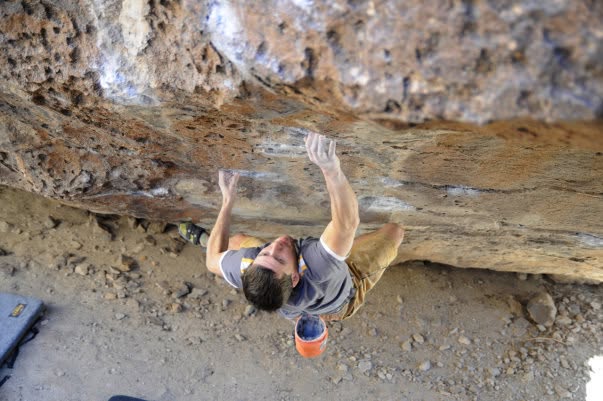
The rock here keeps score.
Sharp iron patina, deep pockets, dry desert air, and a season that only lasts a few months. Hueco eats skin faster than anywhere. Here is how to show up with more of it, keep it through the trip, and climb every day you reserved.
You wait all year for this trip. Don't let your skin end it on day three.
Hueco is the trip. You drive a long way for it, you camp for it, you reserve your days for it, and the rock pays you back in pockets, roofs, and skin. The crystals are sharp, the patina polishes, and the classics come down to crimps and pinches you can only try so many times. The strong get shut down here as often as the weak. The difference is usually how much skin is left.
So treat your skin like it's part of the trip. Condition it before you leave. Keep it dry on the warm afternoons. Rebuild it every night at the Ranch so tomorrow is a climbing day, not a hiking day.
Four steps. One trip's worth of skin.
Pick a size, hit Add, keep reading. It goes straight to your cart and the page stays put.
 01Two weeks out
Condition before you leave.
Tip Juice firms and thickens the top layer of skin so the crystals take longer to get through it. Start it ten days to two weeks before you fly, once a night, and your first day on North Mountain feels like your fourth. File calluses flat with the 80/100 every morning. Rolled skin on a Hueco crimp becomes a flapper in one move.


 02The night before
Keep them dry when the patina warms up.
Hueco mornings are cold and the afternoons are not. By two o'clock the rock is in the sun and your hands are the problem. Performance and Dry Spray both go on the night before and do their work while you sleep. Cream if you like a cream, spray if you like a spray. Some climbers swear by a hit of Dry Spray right before a burn too. Both cut sweat at the skin with no aluminum, so they feel like your own hands. Less chalk on the holds, more friction on the crux, and the rangers like clean rock.


 03Every night at the Ranch
Rebuild it overnight. Every night.
This is the ritual that makes a two-week trip possible. Wash the chalk off, work a pea of Repair into the pads and the backs of your fingers, and sleep. Most people wake up with tips they didn't expect to see until Thursday. Split handles the small stuff, the crack on the side of a finger, the gobie from the roof. Split+ is a whipped balm for the second week, when every tip has a slice in it and the desert air has turned them to cardboard. Glue is for the day you climb anyway.


 04By the fire
Pockets load the pulleys. Take care of them.
Hueco is a pulley trip. Pockets and crimps all day, roofs that load the shoulders, heel hooks that find hamstrings you forgot about. Massage Cream warms up forearms, fingers, and the low back after a day of compression. Fair warning: it's capsaicin, you'll feel it working. The acupressure ring lives in the chalk bag for between burns. Tape backs up the finger that's been talking to you since the warm-up boulder.


Tell us what happens. We'll point.
No score and no wrong answers. Pick what sounds like you, and every answer opens another door: a fix, a page, a longer read.
Hueco, on film.
Clips from our Instagram and the crew.
 Hueco Tanks State Park & Historic Site
People came here for water for a thousand years. Climbers came for the rock.
The huecos are the hollows that hold rainwater after a storm, and in the Chihuahuan Desert that made this place matter long before anyone pulled on it. The Jornada Mogollon were living here around 1150 AD and left behind the largest collection of painted masks in North America, along with Tlaloc the rain god, the Starry Eyed Man, and the deer, snakes, and dancers added by the tribes that followed. The park is a historic site first and a climbing area second, and that is why it's run the way it is.
Climbers showed up in the 1950s, when college kids from what's now UTEP toproped the slabs on North Mountain and Royal Robbins put up the first lead routes on the front side. But Hueco became Hueco in 1983, when John Sherman arrived and spent the rest of the decade putting up more than four hundred problems, some of the hardest in the country. When he wrote the guidebook in 1991 he needed a way to grade them, and the V-scale was born. Every boulder problem on earth carries his nickname. Vermin.
Fred Nicole brought the first V14s in America here in 1998. By then the park was seeing eighty-five thousand visitors a year, chalk on the rock art, and trails everywhere. The 1998 Public Use Plan was the answer: seventy self-guided climbers a day on North Mountain, and the rest of the park by guided tour only. It gutted visitation overnight and it's the reason the place still looks the way it does.
Syenite porphyry. It sounds like a disease and it climbs like one.
Hueco's three mountains are one igneous intrusion that cooled underground about 34 million years ago and has been weathering out of the desert floor ever since. Big feldspar crystals in a fine matrix, with iron oxide baked into a dark, glassy patina on top. The patina is what you climb. It takes skin three ways at once.
It cuts.
Tiny crystals stand proud of the surface like a cheese grater. That's where the flappers and the little slices on your pads come from, usually on the move you weren't expecting.
Fix: condition before, file flat every morning →It polishes.
The classics have seen thousands of hands and the patina has gone glassy. Warm it up in the afternoon sun and tips start greasing off holds you stuck at nine a.m.
Fix: dry hands, less chalk, a brush →It loads.
The huecos themselves: one-pad crimps on the lip, mono-friendly dishes, big two-hand jugs through the roofs. Pockets load the pulleys and the desert air dries everything out overnight.
Fix: warm up, ring, tape, rebuild nightly →
The style is physical.
Hueco is roofs, compression, and heel hooks. The feet matter as much as the hands and the moves are big, body-tension affairs between features instead of delicate footwork up a face. You campus out of caves, squeeze blunt arêtes, toe-hook upside down and pull through on pinches. It's the kind of climbing that leaves your core sore and your tips raw at the same time.
Classic warm-ups on the Warm-Up Boulder and the Mushroom Boulder see thousands of hands a season and the holds show it: slick, polished, unforgiving. That's the park. Plan the skin accordingly.
Pack for itThe kit, bottle by bottle.
What each one does, when it goes on during the trip, and a button that puts it in your cart. Travel sizes fit a crash-pad pocket.
Thickens the top layer of skin so the crystals take longer to get through. Nightly before the trip, mornings on rest days.
$12.95Aluminum-free sweat control that soaks in overnight. Hands show up dry for the warm afternoons on the patina.
$8.95Same night-before routine as Performance, in a spray that dries in seconds. Plenty of climbers hit it right before a burn as well.
$8.95The cornerstone. Rebuilds what the crystals took while you sleep. Wash the chalk off first, then a pea-sized amount into the pads.
$8.95Whipped balm for extremely damaged, split, rough skin. Goes on thick, stays put, gets you to the next climbing day.
$8.95
Light aloe spray for skin that goes glassy in dry air. Keeps tips grippable mid-session without softening them.
$8.95The trip packs.
The whole system in one box. Pro Pack for a long trip or a crew, New To Rhino if you want to find out what works on your skin before you commit, and the Sweat Block Bundle if your hands are the thing that greases off first.

Condition, grip, repair, and recover in full sizes. Enough for the season.

Travel sizes of the core four. Find your skin's favorites on the trip, restock when you get home.

Performance plus Dry Spray at a bundle price. Run both if you chalk up every move.
Skin notes from the park.
Day one is a sacrifice.
Don't try the project on day one. Climb easy, let the skin adjust to the crystals, save the hard pulls for when your tips have thickened up.
File before, not after.
Sanding wrecked skin at night just thins it. File flat in the morning, moisturize at night.
Brush the holds, not your skin.
Chalk buildup on polished patina is slicker than the rock. A brush does more for friction than another dip in the bag.
Hydrate works on the drive too.
The desert dries your hands out while you're sitting still. A quick spray between problems keeps skin from going glassy.
Wash the chalk off.
Chalk pulls moisture all night. Cleanse or Castile Wash at the Ranch sink, then Repair, then sleep.
Rest days are skin days.
Tip Juice in the morning, Repair at night, hands out of the dishwater. Two rest days back to back and you'll climb better on day seven than day two.
Show up with skin. Leave with sends.
Our athletes spend their winters in the park and beat their hands up for a living. If you're putting in the sessions and want a crew that gets it, we'd love to have you.
The Rhino Deep Dive
Want the long version?
What is in each bottle, what it does, and when to reach for it. Ingredient by ingredient, sport by sport, in one book you can flip through.